

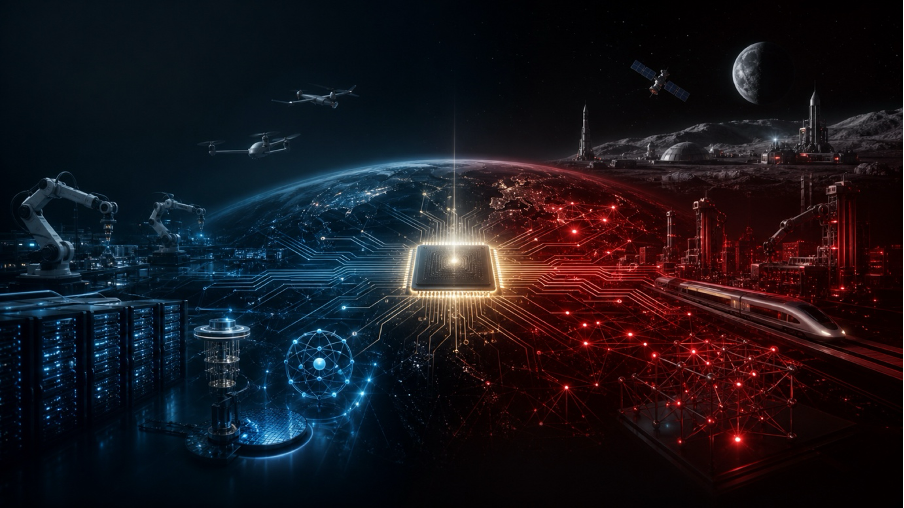
Disruptive change ahead
Raymond Kurzweil, a well-known futurist with significant contributions to artificial intelligence, pattern recognition, and predictions about the “technological singularity,” believes that in the next decade we will witness progress in science and technology as great as that recorded throughout the entire past century. That means going from Ford’s Model T to the “Starship” spacecraft within the next 10 years, as noted by Peter Diamandis, host of the thought-provoking podcast “Moonshots,” in a recent conversation with Michael Kratsios, President Donald Trump’s science and technology advisor.
That translates into enormous, disruptive changes (a concept introduced by Harvard professor Clayton Christensen), which will fundamentally reshape global economic hierarchies; winning and losing industries; military technologies; and the way wars are fought—with drones and autonomous aircraft piloted by artificial intelligence and sophisticated systems for countering drones and missiles, on land or in space, something we already see today in Ukraine and the Middle East—and will ultimately decide who dominates the world and the new spheres of influence.
“Robotics represents, for me, one of the three areas that tend to change warfare. The number of remotely piloted vehicles will increase; we will see an ever-greater delegation of decisions to non-human systems, for example, intelligent mobile drones. “In the current context, this sounds like a banal statement. AI-piloted drones or autonomous vehicles are present on the fronts in Ukraine and the Middle East. What is remarkable, however, is that this was said 24 years ago: in 2002, Andrew Marshall, then director of the Pentagon’s Office of Net Assessment, made such a forecast in a memo sent to then-Defense Secretary Donald Rumsfeld.
The US-China technology race
Without doubt, the geopolitical competition between the West, mainly the United States, and the opposing bloc coalescing around China and Russia will be decided by who controls advanced technologies and who sets the standards in these fields. Until now, practically all the important technologies and standards operating globally have come from the West. What will happen from now on? China is trying to change this by imposing its own technologies and standards in every cutting-edge field—from artificial intelligence, whether algorithms or robots (the physical manifestation of AI), to quantum computers, nuclear fusion, space technologies, and biotechnology. For instance, the future use of quantum computers, another hot area of geopolitical competition, could effectively blow up all existing encryption technologies, with an almost universal existential impact on cybersecurity, from banking transactions to the military sector.
Another key field of geopolitical competition is space. The Starlink communications system, for example, plays a major role in conflicts such as the war in Ukraine or the Gulf. An article published simultaneously in Der Spiegel and Le Monde, based on an investigation by a Latvian publication that had access to confidential Russian documents, revealed that Russia and China are so concerned about Starlink’s impact that they discussed a three-point strategy to counter it, including the physical destruction of satellites. But that is just one aspect. There are discussions about projects to install data centers in space, a topic that gained major traction after Elon Musk’s intervention—not to mention the frenetic race between America and China for a quasi-permanent presence on the Moon in coming years. Or the energy sector: the Kaleidos portable 1-megawatt nuclear microreactors, made by Radiant Nuclear—a startup launched by a former SpaceX engineer—which require no water cooling and can be shipped in a standard container by plane anywhere in the world, also represent a significant development in a critical field.
AI as the decisive battleground
New technologies will have a decisive impact on our entire existence. They will very likely determine the fate of the geopolitical competition between the United States and China—not only militarily, but also in the economy, in society, in everyday life, including governance models. The accelerated takeover of many administrative processes and decisions by AI solutions, as well as the formidable expansion of population surveillance—not only in China but increasingly in the West too—are just two developments illustrating this phenomenon, with benefits but also corresponding costs.
“Artificial intelligence is the future, not only for Russia but for all of mankind... Whoever becomes the leader in this sphere will rule the world,” Vladimir Putin said in September 2017. That same year, in July 2017, Beijing announced a “Development Plan for a New Generation of Artificial Intelligence,“ aiming to dominate the global AI market by 2030.
There was a recent signal of the attention Beijing pays to this field, which it sees playing an essential role in its quest for global dominance. This year’s World AI Conference in Shanghai was larger than ever, Reuters reports, because it was the first time President Xi Jinping attended.
Open versus closed AI model
In his opening ceremony speech, Xi presented a vision of a new, China-led world order excluding the United States, with China at the head of a coalition of Global South countries to which it will export open-source AI models. “Offering artificial intelligence as a global public good for humanity, without export controls and without proprietary closed-source models like those from OpenAI or Anthropic,” Beijing states—a direct message to Washington and to the different AI approach philosophies: closed models versus open-source ones that allow direct third-party access for integration into industrial production, information processing, and complex technological systems. For comparison, it’s like the difference between various open-source Linux distributions and closed operating systems like Windows or Apple’s iOS.
It is ironic, though, that Xi Jinping speaks of the virtues of “open” systems while China has instituted the most opaque and externally isolated internet in the world, with a firewall blocking access to any external online sources not under Communist Party control (in China you can’t even access Dropbox, let alone Gmail or other apps!), backed by hundreds of thousands of censors monitoring domestic traffic.
In America, the major AI corporations—OpenAI with ChatGPT, Anthropic with Claude (whose revenue grew almost tenfold in the past year!), SpaceX with Grok, or Google with the Gemini suite—have advanced, frontier “closed” models. Other companies can integrate these into production solutions or services; costs aren’t prohibitive, but the reluctance stems from the fact that data generated during these processes migrates to the servers of whoever owns the AI model used. Still, there are plenty of strong American open-source solutions, and in Europe, a strong company in the same category is Mistral, from France.
Two philosophies, one contest
The two approach philosophies will most likely coexist, because integrating AI into production and services doesn’t necessarily require the most advanced AI models. Anyway, open-source solutions are already integrated into many American industrial processes, with spectacular results in labor productivity growth. For example, Cambria, a company producing mainly for the military sector, has configured its entire production process around a philosophy profoundly different from traditional ones—all three shifts can be rapidly reconfigured for different civilian or military production lines. The company’s CEO noted that this will be the dominant way America reindustrializes, rather than mimicking traditional production models transferred from China.
The competition is far from purely technological—the political and geopolitical stakes are enormous. There are also plenty of controversies, such as those concerning the theft of American technologies by Chinese firms. Treasury Secretary Scott Bessent made explicit accusations in this regard, saying there are indications that the Chinese Kimi model, which recently made a splash, has components taken from Anthropic’s Feble5 model.
Meta’s open-source disruption
The stakes of the Sino-American competition are clear: which AI solutions will be adopted globally as a priority, Chinese or American ones? The battle is about “exporting” these models and incorporating them into production and service solutions worldwide. China wants such AI models to be adopted in as many Global South countries as possible. But the United States is also aware of this global stake—David Sacks, Trump’s advisor on AI and cryptocurrencies, and Nvidia CEO Jensen Huang, among others, have repeatedly emphasized that the map of which solutions—American or Chinese—get adopted globally will matter enormously geopolitically.
Meta’s breaking announcement about the launch of its open-source AI model, Muse Glimmer, introduces a major shift in perspective on the Sino-American techno-geopolitical competition. China’s ambitions to dominate the global AI model market face an enormous challenge: a competitor like Meta, with vast distribution capacity for its AI model through its apps and billions of users worldwide (except, of course, in China itself, where they are blocked).
Philosophical dimension of the AI divide
The dispute between “open” and “closed” models is even more complex; beyond the technological and geopolitical dimensions, it also has a philosophical one. OpenAI and Anthropic argue, not without reason, that artificial intelligence belongs to an entirely different category compared to the Linux vs. Windows or iOS relationship. When it comes to open-source models, which give everyone access to the source code, major security risks are introduced. However, this aspect — and others related to AI’s social impact, with its considerable advantages but also serious challenges — is completely overshadowed by the geopolitical dimension of the confrontation with hostile actors.
It is currently hard to say whether one side will end up holding a monopoly in the field. What is nearly certain is that decisions made in different parts of the world will have not only a technological dimension but also a geopolitical one. In any case, the whole discussion only highlights the enormous stakes tied to the technological competition, which will ultimately decide who dominates the world economically and geopolitically as a model of society in the decades ahead. In Xi Jinping’s vision, China aims not just to become the global leader in AI but also, from that position, to control the standards in the field, as well as the norms and AI-based governance models, including population-control capabilities.
Standards as a geopolitical weapon
This is an aspect that is probably not fully understood. When we talk about “standard models” of AI adopted worldwide, we’re talking about something quite different from purely technical standards like WiFi or USB—though even those haven’t been fully decoupled from non-technical dimensions. One example is the EU forcing Apple to adopt the USB Type-C standard for mobile phones or the different rail gauge used in the former Soviet space. In this case, though, the stakes are much higher: these models will be trained; what kind of values will be incorporated in that process? And what input information will be blocked, distorted, or “reinterpreted”? It’s no coincidence that China blocks domestic access to all Western social networks and all information sources “non-compliant” with the Chinese Communist Party’s vision. Beijing’s objective is to expand this filtering mechanism globally as much as possible, amplifying information unfavorable to the West and discouraging information unfavorable to China — an important element of its strategy to achieve global dominance.
As an operating strategy, this is broadly similar to, but far more ambitious than, the approach used with the 5G mobile standard. Through 5G equipment exports, Beijing extended its influence across numerous African countries—again, the primary target for AI-based projects—as well as other continents, extracting in the process an enormous amount of information transferred to China. The business strategy used not only in this case but in many others—for example, photovoltaics, electric cars, or rare earth metals processing—is for Chinese firms to attack the global market, benefit from state subsidies, eliminate competitors, and ultimately achieve monopoly positions.
The Western response on 6G
Americans seem to have learned the lesson. Now, alongside other Western countries, they are cooperating on developing the 6G standard, which will mark a major shift in approach to mobile communications. 6G involves creating an infrastructure combining communications, AI, localization, and environmental sensing, as well as integrating terrestrial networks with satellites, aerial platforms, and other systems for near-universal connectivity. The Global Coalition on Telecoms (GCOT), involving the United States alongside the UK, Canada, Japan, Australia, Finland, and Sweden, is engaged in this joint project, whose strategic goal is to set technical standards for 6G. In March 2026, the coalition launched the “Security and Resilience Principles for 6G,” meant to influence research, standardization, and deployment of secure, interoperable 6G networks with resilient supply chains.
China’s manufacturing lead, America’s data-center edge
China has achieved remarkable success in many cutting-edge technology fields. For example, it has an installed base of over two million industrial robots — far more than the combined totals of America, Europe, and Japan. In 2024 alone, China installed 300,000 new robots, ten times more than America. During a Congressional hearing this past March, Rush Doshi, who served on the National Security Council under Joe Biden, asked, “We lost the solar energy sector, the battery sector, and the electric vehicle sector. Are robotics and artificial intelligence next?” “China believes,” Doshi emphasized, “that it is at a crucial moment in history—a fourth industrial revolution, whose winner will shape the coming century. They are probably right. And we should believe it too.” Indeed, The Telegraph reports that a group of Western executives who visited China came away shocked by the scale of industrial robot deployment there.
The concern, though justified, is probably partly exaggerated. The United States, with its characteristic dynamism, has made remarkable progress lately — take, for example, Tesla’s Optimus robots, produced by Elon Musk’s company. Massive efforts are also underway to secure semiconductor production. Although this vital field originated in the US, in Silicon Valley, Americans outsourced most production to Asia after 1990, mainly to Taiwan and South Korea, keeping only the design work.
China controls critical supply chains, primarily rare earth metals, and holds about a third of global industrial output, being the undisputed leader in fields like photovoltaics and highly competitive in others like industrial robots or space. On the other hand, the United States holds overwhelming supremacy in data centers (according to the Stanford University AI Index Report, there were nearly 5,500 operating in 2025, versus 529 in Germany and 450 in China) and in designing advanced semiconductor chips.
Washington’s science and AI push
As can be seen from the Moonshots podcast conversation with Michael Kratsios, the White House is making extremely sustained efforts to strengthen US competitiveness across all cutting-edge technology fields. The report “Science and a New Golden Age,” produced under Kratsios’s coordination, proposes a strategy to significantly boost productivity in scientific research, which, paradoxically, despite great technological advances in research tools, has halved over recent decades. The second strategic pillar of the Trump administration for accelerating scientific discovery through AI is the Genesis Mission, described as a “Manhattan Project”—type initiative—the first national mission focused on using AI in the service of science.
The main goal of the Genesis Mission is to accelerate scientific discovery using AI across all government agencies, partly by leveraging the exceptionally valuable database of research results from the national laboratory network (the same network that gave birth to the Internet) to train AI algorithms. An interesting detail is that Elon Musk also recently decided to include SpaceX’s accumulated research results in the training programs for Grok, his AI platform.
Europe’s marginal role
Currently, the main actors in this triple-dimensional confrontation — technological, geopolitical, and geoeconomic, with enormous stakes — are the United States and China. Europe largely plays a secondary role, more focused on trying to impose global AI regulations, an effort with little chance of success when you’re technologically marginal. As Michael Kratsios ironically noted in the earlier interview, the EU began its AI “regulation” push back in 2019, before ChatGPT even existed.
Besides suffocating regulations—also discussed by Mario Draghi in an extremely critical report on EU competitiveness (whose total share of world GDP, including the UK, which was close to that of the US in 2010—25 percent then and now—has dropped to 17 percent)—a major problem is expensive energy, a key element for the huge data centers used for AI. Energy is 3-4 times more expensive than overseas or in China, which has driven many corporations to migrate there. For comparison, while Europe discusses billion-euro projects, Jensen Huang said in an Axios interview that in just the last six months over $300 billion was invested in US startups, most in AI and other advanced technologies with military or civilian applications. And David Sacks said on Fox News that capital investment in US digital infrastructure for AI, estimated at $800 billion in 2026, will likely reach $1.4 trillion in 2027.
Germany’s cautionary tale
Speaking of what Rush Doshi said, Germany is a telling example. Those who missed the digital revolution now face a major crisis. The auto industry, which along with petrochemicals was the global symbol of German excellence, has been massively hit by the assault of Chinese electric cars like BYD and Geely. Not only has it lost much of the Chinese market—where, for instance, VW also used to sell 40% of its production—it is now under attack even on its home turf in Europe, which is why VW announced plans to close 4 factories in Germany and lay off 100,000 employees.
AI sentiment: America vs. China
To be fair, America has its own problems, of a different nature. While the Trump administration heavily supports efforts across all advanced technology fields, including reducing vulnerabilities in critical areas like semiconductors and rare earths, the radical left — increasingly influential within the Democratic Party through so-called Democratic Socialists — does everything possible to sabotage the construction of data centers vital for AI. Peter Diamandis cited alarming figures reflecting this rhetoric: while 70 percent of Americans view AI developments with concern or even hostility, 80 percent of Chinese view them positively.
This discrepancy is also discussed by The Economist: in a global Ipsos AI Monitor survey across 32 countries, Americans, Britons, Canadians, and Europeans are more anxious than enthusiastic about AI, while Indians, and even more so the Chinese, sit at the opposite pole. One possible explanation, though certainly not the only one, is that critical discussion of the topic isn’t necessarily encouraged in China. At the same time, in the US it has become part of partisan political rhetoric. Moreover, Democrat-led states are trying to impose draconian restrictions on companies’ use of AI-based technologies and are blocking data center construction (New York Governor Kathy Hochul temporarily suspended all data center construction). David Sacks argues many of these criticisms are unfounded: water consumption, which is recirculated, is far from significant, while electricity consumption—another point raised, with claims it will raise prices for household consumers—also isn’t a real problem, given that a Trump executive order requires data center builders to equip them with their own power sources.
Political risk to the AI race
Some AI-related problems are real, but they are being amplified in a panicked, catastrophic way, and many of the proposed solutions, often ideologically motivated, would inevitably lead to losing the competition with China. Hence the question: What happens if Republicans lose their congressional majority? Especially since recent revelations have shown Beijing’s active involvement, through various organizations funded through different channels, in stimulating and amplifying these protests and pressures.
A few years ago, an image made waves in the media showing Xi Jinping reading his New Year’s speech with a bookshelf behind him that, alongside Marx’s “Capital” and a volume of Mao Zedong’s writings, also held a reference book on artificial intelligence by Pedro Domingos, “The Master Algorithm: How the Quest for the Ultimate Learning Machine Will Remake Our World,” which described how “intelligent machines” will change every dimension of our lives—politics, business, the economy, education, and science—and will change governance and how wars are fought. “We are fully psychologically prepared to let many things fall under the control of artificial intelligence, even if we shouldn’t do that,” Domingos believes. “But ultimately, it’s not artificial intelligence that makes the decisions (something that has started to be contested, for example, by Yuval Harari, who recently talked about a post-human civilization), but those who control it. So who will stand behind the algorithms? Will it be us, or Xi Jinping? That is the question.”